
Radio advertising cost depends on your market size, the length of your ad, how often it airs, and what time of day it runs. There is no single flat rate. A local station builds your price around your specific goals, which means two businesses in the same town can pay very different amounts for very different results.
That flexibility is good news if you are a small or family-owned business. It means you are not stuck choosing between a national commercial budget and no radio at all. You can start with a schedule that fits what you are actually trying to accomplish this quarter.

Key takeaways
-
Your rate is built from market size, ad length, frequency, daypart, and production, not a flat national price.
-
Frequency over time beats a single heavy week at the same total spend.
-
Morning and afternoon drive times typically cost more because more people are listening.
-
Production is often a separate cost from airtime. Ask what is included before you compare quotes.
-
The most useful budgeting question is "What result do I want?" not "What is the average cost?"
What factors determine radio advertising cost?
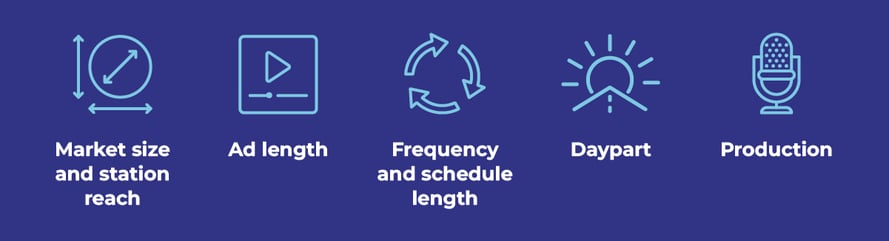
Five things shape the number you see on a proposal: market size, ad length, frequency, daypart, and production. Here is what each one means for your budget.
Market size and station reach
A station serving St. Cloud prices differently from one serving the Twin Cities because audience size and reach differ. This is the single biggest factor in your quote, and it is also why generic average radio ad cost numbers you find online rarely apply to your specific market.
Ad length
Most radio spots run 15, 30, or 60 seconds. Shorter spots cost less per airing, but a 15-second ad has to work harder to make one clear point. Many local advertisers find 30 seconds is the sweet spot, long enough to tell a real story, short enough to stay affordable across a full schedule.
Frequency and schedule length
A single ad rarely moves the needle. Radio works through repetition, so your cost reflects how many times your spot airs over how many weeks. A four-week flight with consistent frequency almost always outperforms one heavy week followed by silence, even at a similar total spend.
Daypart
Morning drive, roughly 6 a.m. to 9 a.m., and afternoon drive, roughly 3 p.m. to 6 p.m., typically carry higher rates because more people are listening. Midday and evening slots cost less and can still reach your audience well, depending on when your customers are in the car, at work, or at home.
Production
If you need your ad written, voiced, and produced, that is usually a separate line item from airtime. Some stations include basic production in a package. Others quote it separately. Ask up front so your budget covers the finished ad, not just the time slot.
See our guide on what’s included in a radio advertising package.
How much does a 30-second radio ad cost?
A 30-second spot is the most common radio ad length, and its price scales with the same factors above: your market, your daypart, your frequency, and whether production is included. Rather than looking for one universal number, ask your station to quote a 30-second spot at the frequency and daypart you actually need, then compare that quote to your goals, not to an average from a different market.
How do I budget for radio advertising without guessing?
Instead of asking what does radio cost, ask "What result am I trying to buy?" A media rep can build a schedule around a target number of weekly impressions or a specific campaign goal, then show you what that costs in your market. That is a more useful starting point than any national average, because it is built around your business. For a closer look at whether that spend pays off, see Radio Advertising ROI: What Should You Expect?
Frequently asked questions
Is radio advertising too expensive for a small business?
Not necessarily. Because pricing is built around your market and schedule, a small business can start with a modest flight and scale up once it sees results, rather than committing to a national-size budget.
Why do radio ad prices vary so much between stations?
Audience size, time of day, and how in demand a station’s inventory is all affect price. A station with strong local listenership in your target daypart will typically cost more than one with a smaller or less engaged audience.
Does a longer ad always cost more?
Usually yes, per airing. But a well-written 15- or 30-second spot can outperform a longer one that buries its message. Length should match what you are trying to say, not just your budget.
What is included in a radio ad price besides airtime?
This varies by station. Some packages bundle production, digital add-ons, or event mentions. Others price airtime and production separately. See our guide on what’s included in a radio advertising package.
Is there a radio ad cost calculator I can use?
Most stations do not publish a self-serve calculator because rates depend on your specific market and schedule. The closest thing is a conversation with a local media rep, who can build a real quote around your goals in minutes.
Next steps
If you want a real number instead of a range, talk to a local media expert and get a quote built around your market, your schedule, and your goals.
